
Skip to content
MENU

Sustainability Consulting

APTIM helps organizations manage environmental impacts, reduce risk, and move from planning to measurable results. Whether you are developing a sustainability strategy from the ground up or working to improve operational efficiency, we provide the clarity and support needed to achieve meaningful progress.

Organizations are under increasing pressure to cut costs, navigate an expanding patchwork of regulations, and mitigate climate-related risks that threaten operations and reputation. Many teams lack the bandwidth, data capabilities, or organizational alignment needed to keep pace with these expectations. As demands grow, the right support provides the clarity, capacity, and structure organizations need to respond effectively.

APTIM helps organizations manage environmental impacts, reduce risk, and move from planning to measurable results. Whether you are developing a sustainability strategy from the ground up or working to improve operational efficiency, we provide the clarity and support needed to achieve meaningful progress.

Sustainability paths are rarely linear. Increasing climate-related risks, regulatory changes, and growing stakeholder expectations create a complex operating environment for sustainability teams. With limited time and resources, identifying and advancing the right initiatives can be challenging, particularly when multiple priorities compete for attention. Our services across climate, waste, energy, water, and packaging provide the direction and support needed to turn those priorities into progress.
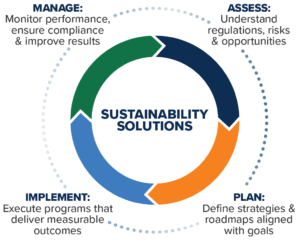
Workflow of how APTIM can help with an organization's sustainable solutions.

How APTIM Can Help

APTIM offers a full-service approach that integrates assessment, strategic planning, disclosure reporting, and implementation support. We help organizations identify cost-saving opportunities, reduce operational risk, and develop strategies that are both regulatory compliant and operationally efficient. Our experts work as an extension of your team, making complex requirements more manageable and enabling measurable progress.

Climate and Risk Services

APTIM evaluates climate-related risk and provides strategies that help organizations prepare for the future through climate adaptation and resilience planning. We integrate research, modeling, and technical expertise to translate complex data into clear, actionable pathways that strengthen environmental resilience.

  • Materiality and double-materiality assessments
  • Climate risk and vulnerability assessments
  • Scenario modeling and peer benchmarking
  • Education and stakeholder engagement
  • Strategy and implementation
  • Emergency and disaster recovery

Sustainable Waste Services

Waste management represents one of the most significant and visible opportunities to reduce costs and environmental impact through waste minimization and resource optimization. Our team evaluates existing systems, identifies gaps and inefficiencies, and designs programs that improve regulatory compliance, support waste diversion goals, and streamline operations from facilities to enterprise-wide programs.

  • Regulatory review
  • Waste reduction and prevention strategies
  • On-site and virtual waste assessments
  • Roadmapping
  • Project development, implementation, and management

Energy Management Services

Energy remains a central driver of operational costs and greenhouse gas emissions. Through detailed assessments, regulatory guidance, and implementation support, our teams identify energy efficiency improvements and funding opportunities that align with long-term sustainability objectives, reduce financial exposure, and support emissions reduction goals.

  • Regulatory review, including benchmarking and building performance standards
  • Utility bill analysis
  • On-site energy assessments
  • Identification of funding sources
  • Roadmapping
  • Project support and implementation

Water Efficiency Services

Water efficiency requires both clear visibility into usage patterns and thoughtful planning. Our assessments identify where water use is highest, where efficiencies can be achieved, and which improvements deliver the greatest operational and financial value for your organization.

  • Regulatory review
  • Utility bill analysis
  • On-site water assessments
  • Water risk assessments
  • Roadmapping
  • Identification of funding sources
  • Project support and implementation

Extended Producer Responsibility (EPR) Services

With packaging EPR laws expanding across the country, organizations need clear guidance on regulatory obligations and reliable systems to manage reporting and packaging decisions. Our approach focuses on developing integrated, long-term solutions that support compliance while ensuring organizations remain prepared as regulations and expectations continue to evolve.

  • Regulatory review and producer applicability assessments
  • Data management
  • Reporting support
  • Contract and risk mitigation
  • Packaging strategy development
  • Reuse program planning and implementation

The APTIM Advantage

  • Adaptable: We support organizations at every level, from individual facilities to enterprise-wide operations and supply chains.
  • Collaborative: Our approach integrates innovation, technology, and best practices to deliver effective outcomes. We work closely with clients to understand operational challenges and develop fit-for-purpose, cost-effective solutions.
  • Custom solutions: Every organization is different. Our strategies are tailored to specific goals, challenges, and opportunities for environmental and financial performance.
  • End-to-end partner: From strategic climate risk advisory to hands-on implementation, we serve as a trusted partner throughout every stage of the sustainability journey.
  • Whole-systems sustainability: We identify opportunities by evaluating entire systems rather than individual operations, resulting in programs that conserve resources, support innovation, and deliver value across the organization.

Our Thought Leadership

APTIM’s Sustainable Sport Index is a first-of-its kind annual survey and benchmarking report for professional sports venues. It delivers in-depth insights into environmental practices and highlights trends and opportunities shaping sustainability performance across the sports industry.

APTIM’s Environmental Retail Index (ERI) adapts the Sustainable Sport Index model for the retail sector, helping organizations understand environmental performance across the industry. The ERI report enables retailers to benchmark performance against peers and provides data-driven insights that support achievable environmental improvements.

Sustainable Sport Index (SSI) logo for APTIM benchmarking report.


Our Commitments

In addition to the work we do supporting clients to achieve their sustainability goals, APTIM is also committed to net zero greenhouse gas emissions by 2040. Our emissions reduction goals are validated by the Science Based Targets initiative and affirmed by our commitment to the Amazon Climate Pledge. Learn more about our sustainability commitments.

 

Sustainability Consulting Frequently Asked Questions

Improvements in energy, water, and waste management often lead directly to lower operating expenses. Identifying inefficiencies, optimizing equipment and processes, and improving resource management can reduce both environmental impact and overall spend. Many organizations begin with audits or benchmarking to identify the most cost-effective opportunities for improvement.

Organizations should begin by reviewing existing data and identifying gaps in performance or reporting, then adjust goals to reflect what is achievable with available resources. Focusing on actions that deliver near-term progress, such as improving data accuracy or addressing the most significant sources of impact, can help build momentum. Many organizations also revisit their sustainability roadmap to better sequence actions and allocate resources more effectively.

Climate risks are evaluated by examining exposure to physical hazards, such as heat, flooding, severe storms, and supply chain disruptions. Many organizations use vulnerability assessments, scenario analysis, and modeling to understand where impacts are most likely to occur. These insights support planning, investment decision-making, and long-term resilience strategies.

Preparation typically begins with reviewing available data, identifying gaps, and aligning internal processes with recognized disclosure frameworks. Organizations often conduct gap assessments, review applicable regulations, and evaluate climate-related risks and opportunities to understand reporting requirements and establish a clear compliance pathway.

Resilience planning focuses on identifying operational vulnerabilities and implementing measures that reduce disruption, such as infrastructure upgrades, emergency preparedness procedures, and supply chain diversification. Incorporating long-term climate projections into facility and operational planning enables organizations to adapt more effectively and strengthen overall resilience.

Higher waste diversion rates are often achieved by simplifying sorting practices, reducing contamination, and improving signage and employee training. Reviewing current waste streams and hauler contracts can identify opportunities for resource optimization and improved operational efficiency. Many organizations see measurable improvements following a structured waste assessment, which helps identify inefficiencies, inform program design, and support implementation.

A waste audit provides detailed insight into the types and volumes of materials generated, how those materials are managed and disposed of, and where opportunities exist for waste minimization and improved diversion. Audit findings can reveal avoidable costs, reduce excessive fees, and inform more effective waste management programs. In addition, waste audits support performance tracking over time, enabling organizations to measure progress, refine strategies, and improve long-term sustainability outcomes.

Common strategies include upgrading equipment, improving operational controls, addressing building envelope performance, implementing peak load shifting and demand response programs, and integrating renewable or lower-carbon energy sources. Reviewing utility bills and conducting energy audits or facility assessments can help identify the most impactful opportunities. Many organizations prioritize measures that deliver both emissions reduction and cost savings while improving overall energy efficiency.

Energy benchmarking typically involves comparing a facility’s annual energy use with similar building types using tools such as ENERGY STAR Portfolio Manager, which is commonly required by city and state regulatory compliance programs and building performance standards. Benchmarking results help identify underperforming sites and prioritize where deeper assessments or upgrades may be needed. APTIM can support benchmarking compliance, interpret performance results, and guide next steps, including audits, improvement planning, and building performance standard readiness.

While actual savings vary by property, many commercial clients achieve 10% to 30% reductions in energy costs within the first year through improved operational efficiency and targeted energy management strategies. For multisite operations, these reductions can represent significant annual savings, along with measurable decreases in GHG emissions.

A water efficiency assessment evaluates how and where water is used across a facility and identifies opportunities for water conservation and operational efficiency. These assessments can uncover leaks, inefficient equipment, or process-related drivers of unnecessary water use. Organizations use these insights to reduce consumption, support risk mitigation, and lower utility costs through targeted improvements informed by water audit findings.

Beyond reducing utility expenses, improving water efficiency strengthens operational resilience and reduces exposure to water-related risks. A water efficiency assessment provides the data needed to prioritize conservation measures, support long-term planning, and improve performance in regions facing water stress or regulatory pressure. These efforts can also enhance environmental stewardship and demonstrate a commitment to responsible resource management.

Organizations are typically required to report packaging material types, weights, formats, and the volume of packaging sold or distributed within each state. Additional requirements may include recycled content, labeling attributes, and single use serviceware. Accurate data management is essential to meeting regulatory compliance obligations and supporting consistent EPR reporting across multiple jurisdictions.

Opportunities for EPR fee reduction often include using more recyclable materials, reducing packaging volumes through lightweighting and right-sizing, and improving the accuracy and completeness of submitted data. Most states offer reduced fees or incentives for environmentally preferred packaging choices. Understanding state-specific fee structures and supply chain footprints enable organizations to prioritize changes that deliver the greatest impact without compromising customer experience.

Yes. APTIM provides EPR consulting and supports packaging strategy development by evaluating material selection, recyclability, lifecycle impacts, operational considerations, and reporting requirements. Our team also assists organizations in designing or assessing reuse and refill models to ensure alignment with regulatory expectations, cost considerations, and long-term sustainability objectives.

Organizations may need to prepare for climate disclosure reporting requirements, such as California’s SB 253 and SB 261; packaging EPR laws, including Maine’s LD 1541 and Washington’s SB 5022; and composting and organics recycling mandates, such as California’s SB 1383. Additional emerging requirements include waste reduction mandates, water efficiency regulations, and energy benchmarking ordinances. Understanding which regulations apply to specific facilities and operations supports proactive regulatory compliance and helps avoid last-minute implementation challenges.dion Content

Despite monitoring regulatory agencies, industry associations, and legislative trackers, keeping pace with evolving requirements can remain challenging. APTIM provides regulatory review and ongoing advisory support to help organizations identify applicable regulations, understand anticipated timelines, and take actions that support risk mitigation and long-term compliance readiness.

APTIM. In Pursuit of Better.

Submit a Request

Learn more about our sustainability consulting services.