
How to Make Your Retail Supply Chain Data Work for Decarbonization
What strategies can retail sustainability leaders use to enhance the effectiveness of their supplier engagement strategy and accelerate emissions reductions?
This Week's Contributor

On average, 98% of greenhouse gas (GHG) emissions from retail companies originate within the value chain, but much of the source data used to calculate Scope 3 emissions are based on regional estimates rather than supplier-specific information. Collecting primary supplier sustainability data can pose dual challenges of decreased data accuracy and increased resources required to collect and manage it—but strong vendor engagement strategy remains critical to advancing enterprise retail supply chain decarbonization goals.
In this article, we explore how retailers collect supplier data, efforts to increase vendor aptitude, and how tools and third-party sustainability platforms help streamline engagement and collaboration.
How Are Retailers Gathering Supplier Sustainability Data for Retail Supply Chain Decarbonization?
Best Practice: Mandate the use of recognized third-party platforms and audit schemes to collect structured environmental and social data.
The process of collecting supplier sustainability data can be time-consuming and resource-intensive for both retailers and their suppliers. While Excel-based questionnaires are still common, many retailers are transitioning to third-party sustainability data collection platforms to standardize data formatting and reduce the reporting burden for the supply chain. These supplier data collection platforms are frequently used to support long-term retail supply chain decarbonization.
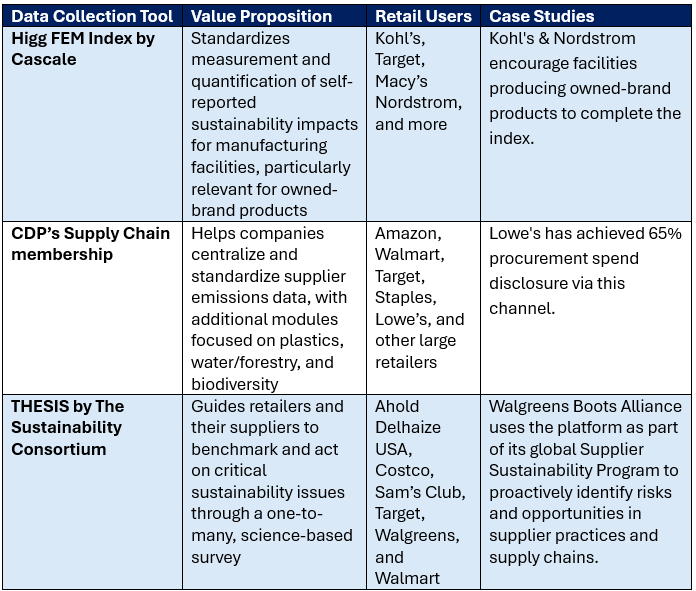 *Case studies and retail users were gathered from publicly available sources, including up-to date sustainability reporting and data collection tool websites.
Before investing in third-party sustainability data collection platforms, retail leaders should consider the following:
- The responses you receive may not be the responses you need. To ensure the data insights you receive are representative of the most significant parts of your company’s footprint, it is important to prioritize vendors that are long-term partners, have high regulatory or physical risk exposure, are critical to operations, and/or have a strong influence on other suppliers. As a rule of thumb, about 20% of your suppliers are responsible for about 80% of Scope 3 emissions—so start by identifying and engaging that 20%.
- Off-the-shelf solutions are almost impossible to come by. Be sure to consider what additional costs will be incurred to integrate data outputs with existing supply chain management software so they are useful and accessible to internal teams.
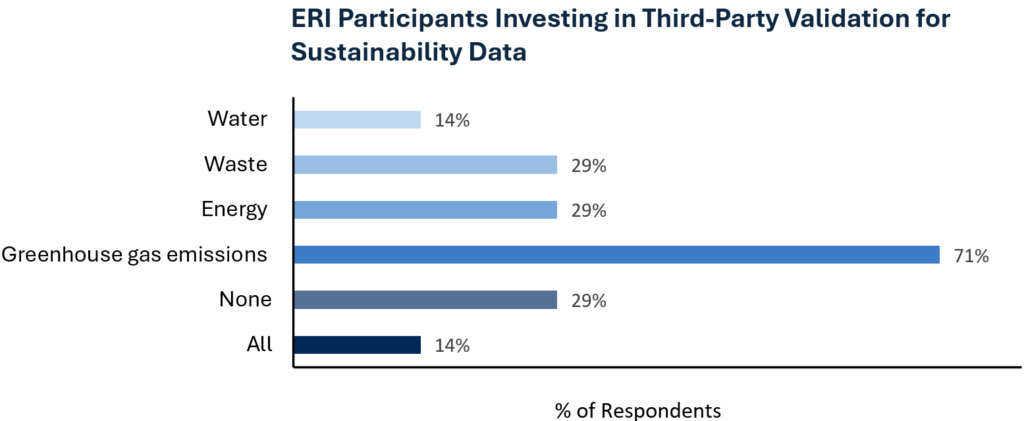
- Self-reported data may be inaccurate. Some suppliers may require third-party data verification to support accurate retail value chain emissions. While approximately 71% of Environmental Retail Index (ERI) participants obtain third-party verification on their own GHG emissions, there may still be inaccuracies upstream that could disrupt progress on your decarbonization goals.
How Are Retailers Building Capacity to Improve Supplier Sustainability Data?
Best Practice: Engage suppliers on a semi-annual basis via collaborative programs and training to prepare them for sustainability reporting.
Providing educational tools for suppliers can improve the quality and accuracy of supplier sustainability data. Webinars, workshops, playbooks, and case studies are common tools to help vendors advance sustainability initiatives and decarbonization efforts; conducting them regularly is important to strengthen supplier environmental data accuracy and meet the demand of evolving product portfolios.
Not every supplier is at the same level of maturity in their climate journey. Some may have never calculated their Scope 1 and 2 emissions, while others may have SBTi-validated targets. Conducting a supplier maturity assessment can help to create categories of suppliers for which tailored training materials are developed and delivered appropriately for their level of progress. Action-oriented training programs—such as how to collect primary emissions data, develop science-based targets, or transition to renewable electricity via joint reduction projects—have proven particularly effective for several large retailers.
Case Study: Kicking off in 2023, Kohl’s held capacity-building sessions in multiple languages for their vendor and facility partners to support their completion of the Higg FEM Index. They also provided a web-based training course on climate change and GHG emissions accounting in collaboration with the UN Fashion Industry Charter.
Behavioral changes such as adding sustainability as a standing item on regular calls and appointing single points of contact to drive progress are also useful for building supplier capacity. For high-priority suppliers that may have resource limitations, some companies have also seen success with a managed sustainability fund to co-fund priority projects.
How Can Retailers Leverage Supplier Contracts to Boost Sustainability Engagement?
Best Practice: Build sustainability data collection and compliance directly into contractual relationships.
Integrating sustainability expectations into contracts and policies can increase the effectiveness of engagement and help reduce the burden of supplier training as brand and product offerings change on an annual basis. Many retailers already set clear expectations through policies like vendor codes of conduct, though prerequisites for sustainability efforts and/or performance are yet to be widely adopted.
According to participants of APTIM’s ERI, only 17% use supplier selection criteria based on sustainability performance.
Universal sustainability standards may not be realistic, particularly for discount retailers relying on merchandise produced to other retailers’ specifications. However, some retailers are narrowing the scope to focus on specific vendors or activities before piloting more pervasive contract requirements.
Real-World Examples
- One major fashion retailer requires its top 100 suppliers to set GHG emission reduction targets for Tier 1 and 2 supply chains.
- A large home improvement retailer mandates that vendors report details about product packaging to identify opportunities for improvement and manage material specifications.
In addition to contract requirements, some retailers are incentivizing suppliers through awards/showcases, scorecards, and additional commercial benefits (e.g., tender weighting, preferential terms, and longer contracts) to drive decarbonization progress.
Reduce Your Scope 3 Emissions with APTIM
The complexity of global supply chains poses significant challenges for retail sustainability leaders in calculating and reducing retail value chain emissions, but it is important to remember that this is an exercise in continuous improvement.
APTIM’s sustainability experts support clients in:
- Strengthening supplier sustainability data collection
- Improving vendor engagement strategy alignment
- Advancing emissions reduction initiatives
If you are interested in refining your supplier engagement strategy to support emissions reduction or other areas of environmental impact, reach out to our team at EnvironmentalRetail@APTIM.com.
Learn more about APTIM’s sustainability solutions.
Published December 2025
APTIM. In Pursuit of Better.
Connect with APTIM
Subscribe to the APTIM Xchange Newsletter
APTIM's newsletter, The APTIM Xchange, provides industry news flashes, regulatory updates, service spotlights, and topical columns from our subject matter experts.